


Public Stargazing
- Where:
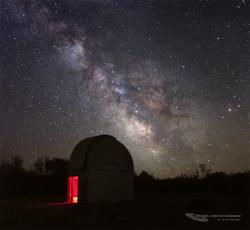
- Frosty Drew Observatory
- When:
- Friday June 14, 2013 at 6:00 p.m.
- Cost:
- Free! Donations Appreciated.
Tonight's skies don't look very promising again this evening, as the torrential rains continue to disturb our views of the night sky. If the sky does clear, the crescent Moon, which is moving its way up toward the weekend's 1st quarter phase, will be a feature, as will be incredible planet Saturn. Also, we have a very bright Iridium satellite at 10:28 P.M., and two fair passes of the International Space Station. The planet Mercury, which is so close to the Sun that it is never in a dark sky, right now is able to be observed, but not with the 16-inch telescope, as it is too close to the western horizon for the next few days right after sunset. Just look for the planet Venus, the brightest object low in the west, then move up just a little bit; binoculars might help to find it.
Whatever the weather tonight, the URI Planetarium will be showing A Starry Tale, a beautiful mythology program from the Japanese company GOTO, makers of precision planetarium equipment and presentations. The program will be shown at 6:00 and 7:00 P.M., and admission is only $5.00, to benefit both the URI Planetarium and Frosty Drew memorial funds. Both presentations will be followed by a short introduction to "The Skies of Frosty Drew," then, if the skies do clear, you are all invited to join us at the Observatory in Ninigret Park.
Don't forget, if you have young children or grandchildren, think of having them enjoy a week with the Frosty Drew naturalists. Nature Weeks is a wonderful way for the younger set to be introduced to the world of life science. If you'd like more information, please visit the Frosty Drew web site.
Frosty Drew Observatory is privileged to be located within the Town of Charlestown, which is working to keep its dark, rural nature. Please help us to keep the skies dark for the enjoyment of all.
-Francine Jackson
-------------------------------------------------------------------------
Tonight, every forecaster is calling for a different take on partly cloudy skies in the evening becoming clear overnight, with one (rather unreliable) forecaster calling for a thunderstorm. The 31% waxing crescent moon will set at 11:48 offering us a beautiful view of the bright crescent with clear earth-shine illuminating the shadow side. We will attempt to open at 6:00 with solar projection in the Sky Theatre, Observatory, and on the grounds. At 8:30-8:45 we will attempt to open the Observatory telescopes with views of Mercury, Venus, Saturn, and the crescent moon. If skies clear and stay clear we could have a fantastic night of observation with little obscuration from the moon. Follow us on Twitter to stay on top of what is happening at Frosty Drew tonight.
As we move through spring and into summer you probably have noticed that our stargazing session is starting quite late, usually around 9:00 p.m. This is common during this time of year as the sun approaches its highest point in our sky known as the “summer solstice”. Next Friday (June, 21) at 1:04 a.m. EDT the summer solstice will take place marking the start of the summer season. On this day the sun will rise at 5:18 a.m. and set at 8:18 p.m. making it the longest day of the year. This happens because the Earth, which is tilted 23°, will be most inclined in the northern hemisphere towards the sun. While we move through these months surrounding the summer solstice, come out to Frosty Drew for views of the sun every Friday afternoon starting at 6:00 p.m.
Have you ever thought about life and the challenges (and awesomeness!) of living on the International Space Station (ISS)? Chris Hadfield, a Canadian Space Agency astronaut and commander of the recently completed Expedition 35, really brought a practical view of life on the ISS to the earthbound population. His frequent tweets and YouTube posts (usually answering questions about demonstrating every day activities without gravity) have really shinned on the already super popular ISS. Continuing the popular practice of bringing ISS life to all of us here on Earth, NASA has setup a continuous LIVE video and audio stream from the station. This live stream displays internal views when the crew is on-duty and Earth from 230 miles up at other times. When available, audio conversations between the crew and mission control will accompany the video. With the ISS orbiting the Earth once every 90 minutes and experiencing a sunrise or sunset every 45 minutes there will be frequent loss of signal periods which will produce a brief blue screen. Wait it out because awesome views of crew activity, Earth (so sexy!), lightning, aurora borealis, and beautiful sunrise / sunsets from space abound in this fantastic addition to the station that tells the story of human exploration, perseverance and strive for excellence!
Tonight the mosquitoes will surely be taking reservations. Pants, sleeves, and closed-toe shoes will be a necessity in keeping yourself off the menu.
-Scott MacNeill