


Public Stargazing and Summer Solstice
- Where:
- Frosty Drew Observatory
- When:
- Friday June 21, 2013 at 6:00 p.m.
- Cost:
- Free! Donations Appreciated.
Tonight's skies look absolutely beautiful, so it seems as if the Observatory will be open. The early objects will be our waxing gibbous Moon, on its way to the weekend's Full phase, the Full Strawberry Moon, and our beautiful planet Saturn. Also Venus is low in the west; Mercury, a pleasant surprise in our recent skies, is on its way back to toward the Sun, and won't be a good view again for awhile. In addition, we have a bright pass of the International Space Station beginning at 10:13, when it will appear from low in the west-northwest. Plus, we have three Iridium flares, at 9:33, 10:14, and 10:15.
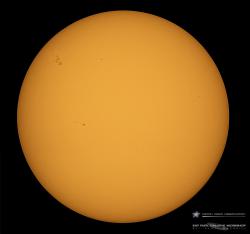
And, don't forget: Before dark, we will be doing very safe solar observing. This is a great opportunity to safely see our very own star.
You probably know that when you woke up this morning, a new season had begun. Summer started at 1:04 A.M., when the Sun, in its apparent path in our sky - the ecliptic - was as far above the celestial equator - our own equator extended outward into the sky - and now has stopped its apparent upward journey and will appear to move back toward the celestial equator. When the Sun reaches this highest point, it stops (Sun stops = solstice) formally beginning our summer.
We're hearing in the news that the Moon is at its closest position to the Earth during Sunday's Full phase, so the "Supermoon" rumors are coming back. The Moon travels around the Earth in an elliptical orbit, so there are times when it is closer to us than others. On Sunday, it will be at its nearest for this year; however, if you go outside to observe it, you may be disappointed - it will look pretty much like every other Full Moon. Which is not to say that Full moons aren't a beautiful sight: It just will appear as nice as any other one this year.
Frosty Drew Observatory is privileged to be located in the beautiful town of Charlestown, which is doing its best to keep its rural character, most notably by its passage of last year's lighting ordinance. Please help us to keep this part of Rhode Island as dark as possible.
-Francine Jackson
-------------------------------------------------------------------------
Today is the Summer Solstice, welcome Summer! The forecast tonight is calling for clear skies with a slight chance of fog before dawn. The 95% waxing gibbous moon will be with us all night significantly brightening up the sky. We will open this afternoon at 6:00 with views of the sun's photosphere showcasing a bunch of sunspots that should be quite visible. Then at 9:00 we will open the observatory telescopes with views of the bright moon, Saturn, and possibly and early sighting of Venus.
On Sunday morning (June 23) at 7:00 a.m. the lunar perigee will take place shortly followed by the moon reaching its full phase, effectively making this the largest full moon of the year. At this time the moon will be at its closest point to Earth in its orbit. The media has popularly coined the lunar perigee coinciding with a full moon event the “Supermoon”. I am sure you will hear much hype about how big and bright the “Supermoon” was, but in reality the size and brightness differences from other full moon phases of the year are minimal. The lunar apogee and full moon on January 14, 2014 (the point at which the moon is at its furthest from Earth during a full phase) will be 12% smaller than this weekend's lunar event. Likewise, be sure to step outside for a view of the Supermoon. The best time to observe will be Saturday just after sunset, but any time this weekend will be great.
This morning, sunspot AR1777 unleashed an M2-class solar flare. The flare was not directed towards Earth, so no northern lights for us. But the active AR1777 sunspot is slowing moving into position to possibly blast flares our way. NOAA forecasters estimate a 30% chance of M-class flares coming our way from this active sunspot and a 5% chance of X-class flares during the next 24 hours. Keep your fingers crossed as all of us in New England have been thwarted by the northern lights this year to date.
When visiting the observatory tonight be sure to dress for mosquitoes. We have had a good year so far but the recent increase in rain could bring them back. Long pants, closed-toe shoes, and sleeves are a necessity. Happy first day of Summer!
-Scott MacNeill