


Public Stargazing
- Where:
- Frosty Drew Observatory
- When:
- Friday July 12, 2013 at 6:00 p.m.
- Cost:
- Free! Donations Appreciated.
As has been the case lately, the skies aren't allowing us to open the observatory this evening, but, if you’d like to witness an artificial sky, the University of Rhode Island Planetarium will open tonight. At 6:00 and 7:00 P.M., in honor of the month of July as the anniversary of the first footprints placed on the Moon, the featured selection will be Dawn Of the Space Age an introduction to the history of spaceflight by both the United States and the Soviet Union, from 1957’s Sputnik to a hoped-for future to Mars. Admission is only $5.00 per person, to benefit both the URI and Frosty Drew Memorial funds, and the program will end with The Skies of Frosty Drew, what is in the night sky at this time. The URI Planetarium is located on Upper College Road, at the intersection of Engineering Row.
Two weeks from tomorrow, on July 27th, mark your calendars for the Frosty Drew 3rd annual Sea Star Marketplace, a day of arts celebration, featuring exhibitors showing their painting, pottery, jewelry, woodworking, and all other forms of artwork. Looking for something unique for your home, or gift for a special occasion? Chances are you will find it here. Also, we will have two special guests with us that day. Dr. Giovanni Fazio, Senior Physicist at the Harvard-Smithsonian center for Astrophysics, will intrigue visitors of all ages with information on our universe. He will be speaking at 11:00 A.M. and 2:00 P.M. in the Drew Sky Theatre. Dr. Fazio’s appearance last year was very well received, and he will again enthrall the audience with news of our celestial neighborhood. Also, Kim Arcand, a member of NASA’s High Energy education and public outreach group, and co-author of Your Ticket to the Universe, will be available for speaking and book signing. All in all, it will be a fun time for everyone, and we hope you can all come and enjoy Ninigret Park and our Sea Star Marketplace.
Many people have had trouble adjusting even at this late time with the idea of Pluto now being listed as a dwarf planet, but that hasn't taken the study of this tiny away from us. In fact, we now know that Pluto has five moons associated with it, all named for companions of Pluto, the mythological god of the underworld. The discovery of these satellites is possibly causing a problem for astronomers, as we have sent a space craft, New Horizons, to Pluto, for rendezvous in just a couple years; however, the fact that bodies are being discovered around Pluto could be a concern, as their distance from Pluto must be known precisely, in order not to cause any potential problems with New Horizons's path near Pluto. We’ll be watching this very carefully in the near future.
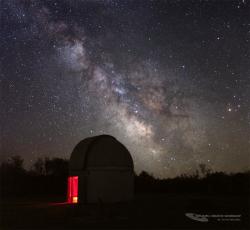
Frosty Drew Observatory is privileged to be located in the darkest spot in Rhode Island. Please help us keep our skies as dark as possible.
-Francine Jackson
-------------------------------------------------------------------------
Tonight's forecast is calling for cloudy skies with periods of rain, t-storms, then fog rolling in overnight. This has pretty much been the entire summer's forecast to date. The 18% waxing crescent moon will set tonight at 10:21 and would have shown off a beautifully thin crescent with a very visible display of earthshine. With such horrible conditions forecast for tonight we will likely keep the observatory closed. Though we will closely monitor conditions and, if skies permit, we will attempt an opening.
This past Wednesday, June 10, a paper was published in The Astrophysical Journal describing in detail a tail that the Sun leaves in its wake as we travel across the interstellar medium though the galaxy. Thanks to ground breaking work being done by the NASA Interstellar Boundary Explorer (IBEX), the boundaries of the tail of the heliosphere have been mapped. This is something that has never before been possible. The tail, similar in thought to what you would see behind a comet, is created by the solar wind (charged particles that leave the sun's corona at escape velocity) blowing out of the sun in all directions. The particles that make up the solar wind travel far past the outer planets, eventually slowing down and falling into the solar system's wake, due to an inflow of interstellar material at the edges of the heliosphere. This tail, called the “Heliotail” is the sun's (and solar system's) foot print on the Milky Way galaxy. Go IBEX!
This past month, the Mars Science Laboratory rover, Curiosity, was able to capture a time-lapse video of one of Mars' moons rising. Mars has two moons, Phobos and Deimos, both which are small and rather rough around the edges when compared to the nice smooth circular shape of Earths moon. Due to popular demand, Curiosity turned its navigational camera to the sky and snapped a bunch of photos of Phobos rising. Phobos has an orbital period of 0.3189 Earth days, is larger than Deimos – making it Mars' largest moon, and appears to a Mars bound viewer as a bright moving star. View the super cool video of Phobos rising.
The skies this summer have been a disaster, similar to what we experienced last year. Lets hope for a clearing soon as I surely miss looking at those stars.
-Scott MacNeill