Frosty Drew Field Studies
"Hands On, Minds On" is our philosophy, and students find a Frosty Drew field study an unforgettable experience. We invite you to select from our nine field studies that approach scientific concepts in life science, earth and space science, physical science, and math in a fun way. Our field studies address Rhode Island GSEs/GLEs and Connecticut’s Common Core of Learning/GLEs and can be adapted to specific curriculum needs. If you have questions or to book a field study, Deborah Hamilton, Head Naturalist, or Francine Jackson, Observatory Director, can be reached by e-mail at fieldstudies@frostydrew.org or by phone at (401)364-9508.
Frosty Drew Program Offerings:
- Life and Earth Science Field Studies
-
- The Salty Life
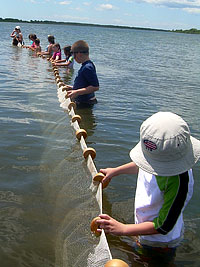
- Students explore life in a salt pond estuary. Using a 40-foot seine net, specimens are collected, examined, identified, and classified. Students discover how each organism obtains nutrition, reproduces, defends itself, and depends on the other organisms. Students will discuss what could disturb the equilibrium.
RI: LS1(K-11), LS2(K-11), LS3(K-11), LS4(K-4, 9-11)
- Seaside Plants
- Students explore the plants on the ocean side and the pond side of a barrier beach. They examine the physical structure of each plant and identify what enables each to obtain nutrition, grow, and reproduce in the harsh environment. Students discover how plants have adapted and the role plants have on life in the coastal life zone.
RI: ESS1(K-4), LS1(K-11), LS2(K-11), LS3(K-11), LS4(K-4, 9-11)
- On the Beach
- Students explore a barrier beach, the estuary behind it, and the animals and plants that live there. Observing the shape of the land, the composition of the soils and water, and the action of waves and wind, they learn how the barrier beach and the salt pond estuary were created and how the motion of the tides, storms, and other factors affect the beach and estuary and the different ecosystems.
RI: ESS1(K-8), LS1(K-11), LS2(K-11), LS3(K-11), LS4(K-4, 9-11)
- Reptiles of Rhode Island
- Reptiles aren't just in the desert! By interacting with a painted turtle, a snapping turtle, and a garter snake, students learn about learn about the diversity of reptiles in Rhode Island and New England. They also discuss reptile adaptations, anatomy, diet, life history, habitats, and conservation.
RI: LS1(K-11), LS2(K-11), LS3(K-11), LS4(K-4, 9-11)
- Estuarine Ecosystem
- Salt pond estuary ecosystems are of great importance to the RI watershed and its wildlife. Students investigate the formation of salt ponds, the properties of salt water and fresh water and their convergence in an estuary, and the effects of run-off and pollution on wildlife and humans. They are introduced to some of the plants and animals central to the survival of a salt pond.
RI: PS1(K-11), LS1(K-11), LS2(K-11), LS3(K-11), LS4(K-11)
- Earth and Space Science Field Studies
-
- Going to the Planets
- Students discover what the planets are made of and how they are different from stars. Students work out and compare the relative sizes of the planets and their relative distances from Earth. Students use the results of these experiments to calculate sizes of and distances to other celestial objects.
RI: ESS2(K-8), ESS3(K-11), PS1(K-8), PS3(K-11), M(N&O)(K-7), M(PRP)(K-8), M(CCR)(K-8)
- The Whirling Wind
- In this program, students learn the reason for wind on the Earth and discuss its various properties and how wind affects various objects. With the aid of wind-related materials, students describe some of the properties of wind and explain how it affects our everyday lives. Using an anemometer that they make, students calculate how fast the wind moves and discuss factors that affect wind velocity.
RI: ESS1(K-8), PS2(K-8), PS3(K-8), M(N&O)(K-7), M(PRP)(K-8), M(CCR)(K-8)
- Our Moon
- Students learn about the motions of the Moon. They discuss lunar and solar eclipses, phenomena that can only be seen from here on Earth. They learn why the moon has the surface that it does and explore the process by which large craters are created by dropping small objects into a soft material and observing the results. Cultural stories are told as well.
RI: ESS2(K-11), ESS3(K-11), PS1(K-8), PS3(K-11), M(CCR)(K-8)
- Stars, Star Stories, and Light
- Students study how stars are formed and what happens to them over time. Through learning about what stars are made of and how far away they are from Earth, they explore the properties of light and of gases. They discuss how people have thought about stars throughout history, including how humans have "joined" stars into constellations.
RI: ESS2(K-11), ESS3(K-11), ESS3(K-11), PS1(K-8), PS2(K-6), M(CCR)(K-8)
- Comets and Meteors
- These celestial bodies have been observed throughout human history. Viewing and discussing images, students learn about some of these famous objects that have appeared in history, find out what comets and meteors are made of, and discover where they come from and where they go. They discuss whether comets are as big as movies and stories make them out to be and make their own comets to take home.
RI: ESS2(K-11), PS1(K-8), PS3(K-8), M(CCR)(K-8)
- The Sun and Time
- Our own star, the Sun, has been used through the ages as a time-keeping source. Students learn that the earth revolves around the Sun at a constant speed and in a predictable way and that people in various lo-cations on the Earth have kept time using the Sun's motion. They discuss the "motions" of time and observe, using a candle, that keeping time involves intervals. Students make old- fashioned timepieces, such as sundial watches and hourglasses.
RI: ESS2(K-11), M(N&O)(K-7), M(PRP)(K-8), M(CCR)(K-8)
- Cost and Availability of Field Studies Programs
-
- For a group of up to 60 students traveling to Frosty Drew’s program in Charlestown, the cost is $7 per student (minimum charge of $70).
- Programs can travel to your area, in which case the cost is approximately $100 depending on group size and length of program (please contact us for pricing).
- Overnight programs are available on request (please contact us for pricing).
- "The Salty Shore", "Seaside Plants", and "On the Beach" due to their outdoor content are available May 1 through October 31. All other programs are available year-round.
If you have any questions or would like to book a program, please contact us by email at fieldstudies@frostydrew.org or by phone at (401)364-9508.
We look forward to working with your group!